

Remembering Peter Washington
The Fight to Save a Historic Cemetery

Peter Washington died free.
Enslaved since birth, Washington was an elderly man by the time of the Civil War. He raised eight children and was a grandfather to at least five grandchildren. However, in just one day, Washington lost his six daughters and five of his grandchildren when enslavers sold them far away in the pursuit of profits.1 Robbed of his loved ones, Washington leaned on his faith as he grappled with his grief, telling a friend “if it were not for my hope in Christ, I could not bear up under this trial.”2
After the Civil War broke out, Washington liberated himself from slavery and made his way to Alexandria, Virginia. Upon reaching the city, he worked with Harriet Jacobs, an abolitionist, educator, and reformer, to help others who’d recently escaped enslavement. Reflecting on Washington’s work, Jacobs noted, “In sunshine and in storm he might have been seen wending his way to some home where affliction had fallen or to the House of worship, where the people listened with rapt attention to his quaint earnest utterances.”3
In the course of conducting his work, Washington became ill and passed away on May 20, 1864. Jacobs noted, “No child of his came to bid him a last farewell, they are scattered I know not where, his two sons are in the army, battling for the country their father loved in spite of her persecutions to him and his.”4 Still, the many community members who attended the funeral meant that Washington was not forgotten. In reaching freedom, he’d been able to find a new family who made sure to turn out and bid him a final goodbye.
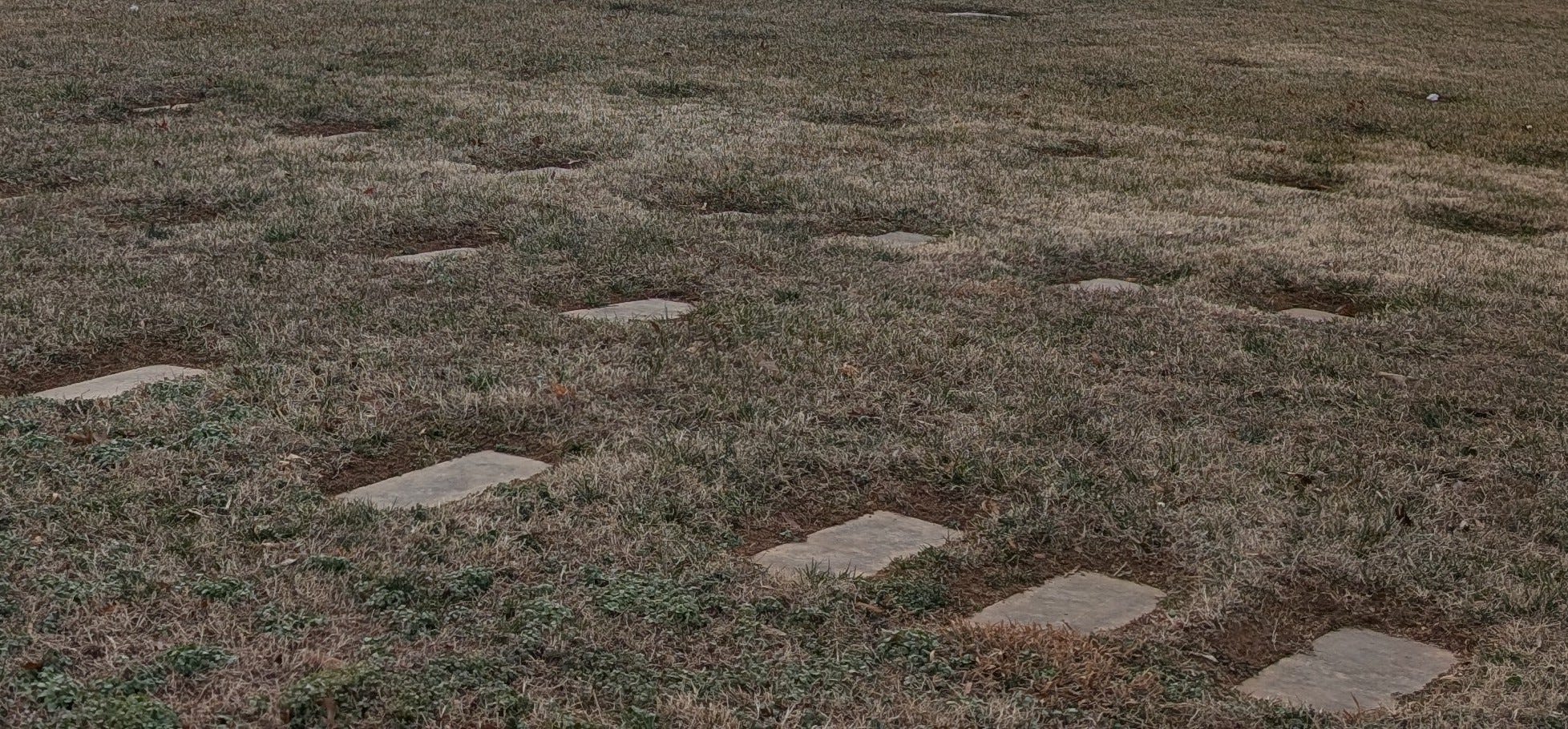
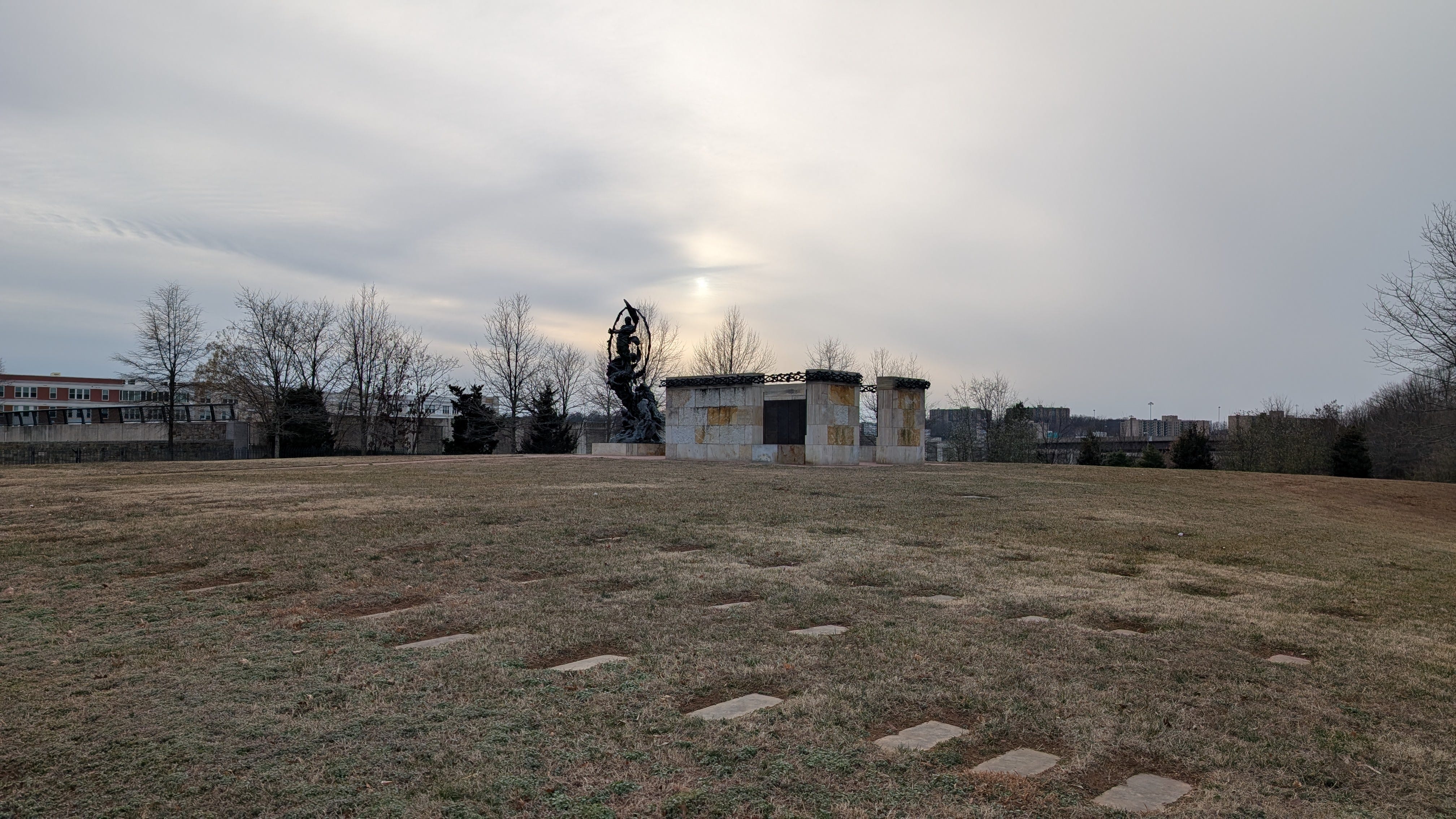
On a cold day three weeks ago, I visited Peter Washington’s burial site. Today, the cemetery is impossible to miss, but that wasn’t always the case. Had it not been for the efforts of dedicated Alexandrians, the burial ground where Washington and many other freedom seekers were laid to rest might have been lost forever.
Finding Freedom
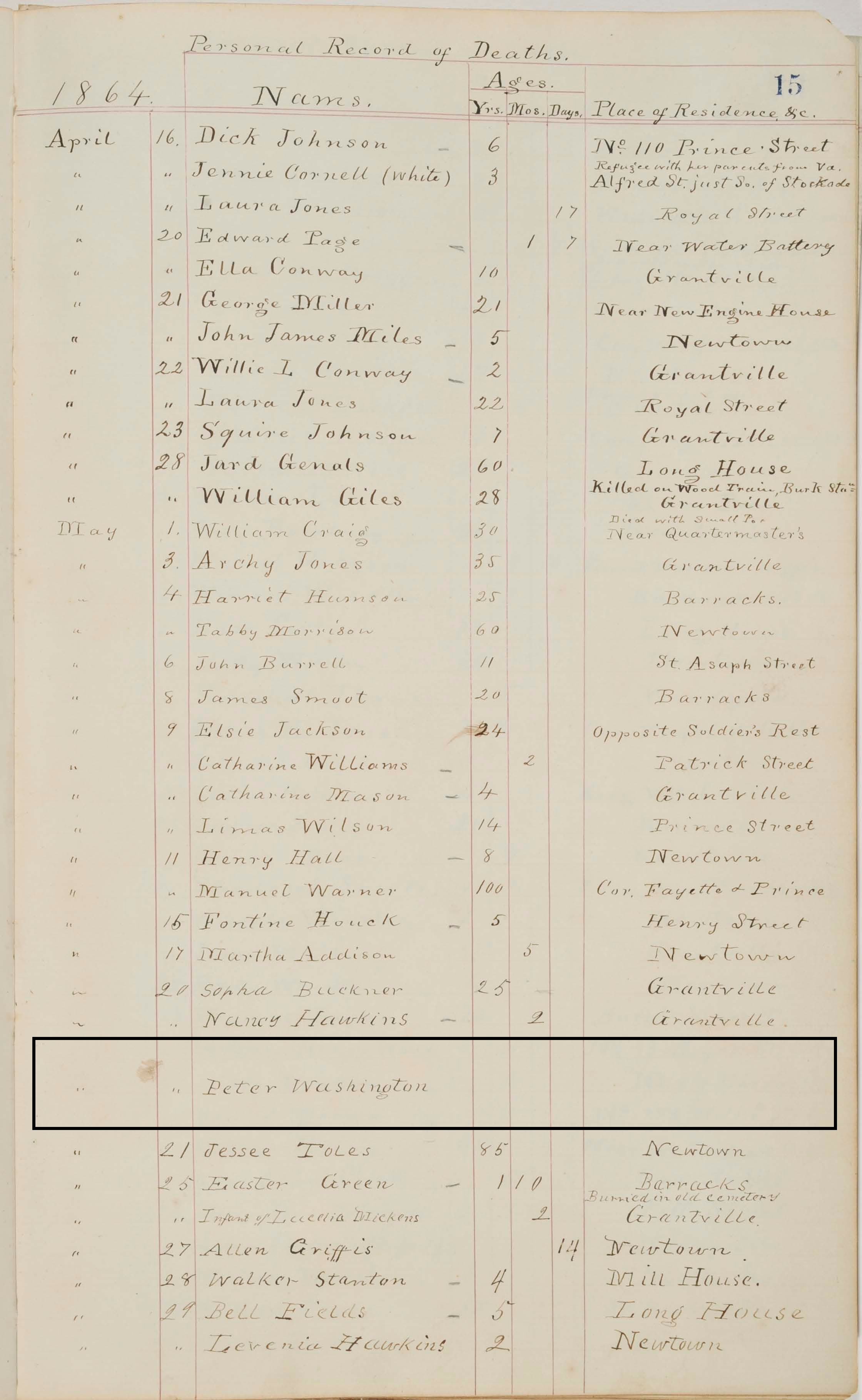
We don’t know much about Peter Washington. Harriet Jacobs’ letter about his life and death is our main source, and I was unable to uncover any other documentation discussing where he was enslaved, his enslaver(s), or the identities of his children and grandchildren.5 His entry in the Gladwin Record, a log of marriages and deaths among Alexandria’s Black community during the Civil War era, contains only his name and his date of death.
What we do know is that Washington was among the thousands of men, women, and children who self-liberated themselves from slavery by fleeing to the US garrison at Alexandria during the Civil War. Initially classified as “Contrabands” by the federal government, freedom seekers like Peter Washington helped doom the Confederate war effort. By self-liberating themselves from slavery, they denied their labor to Confederate authorities. Upon reaching areas under Union control, many found employment as workers for the US military, helping to build the fortifications and sustain the supply lines that protected US soldiers and supported operations into Confederate territory. Some, like Washington’s two sons, enlisted in the military, and took to the battlefield against their former enslavers.
We also know that Washington was laid to rest in what is today known as the Contrabands and Freedmen Cemetery on South Washington Street. While many freedom seekers successfully started new lives in Alexandria, life in the Port City also presented many challenges. Housing was insufficient, disease was rampant, and supplies and government support were often limited. Many freedom seekers fell ill and died. In need of a place to bury the dead, Federal authorities confiscated land for use as a cemetery. Burials began in March 1864, meaning that Washington was among the first people to be laid to rest there.6
Paved Over
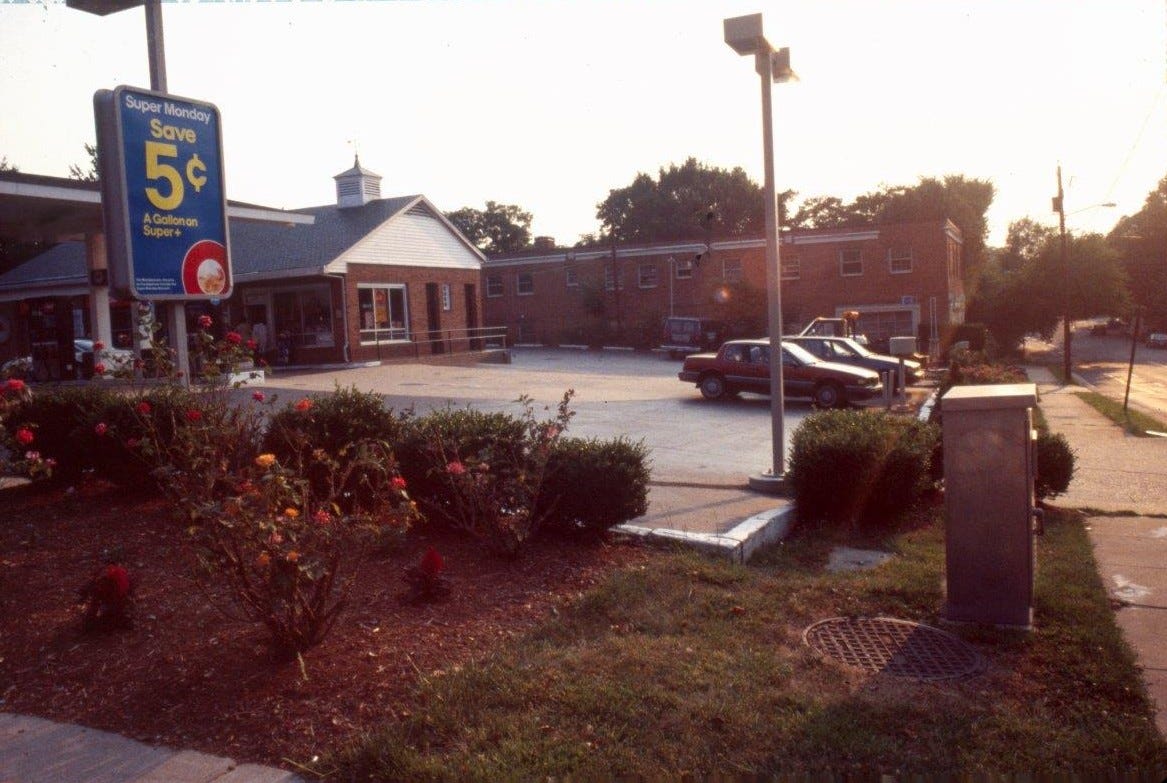
The freedmen’s cemetery was managed by the Federal Government until 1869 and historians believe that burials continued there for some years after that.7 Eventually, the site’s pre-war owners regained control, and they had no interest in maintaining the space. As the site changed hands over the years, the gravesites began to fall into disrepair. Commercial and industrial activity damaged and destroyed many graves.8 In 1955, the site’s owners built a gas station on top of the cemetery. Five years later, an office building went up next to the gas station.9
As the cemetery’s physical footprint was built over, its history was being actively shunted aside. Despite Alexandria spending less than 24 hours as part of the Confederacy (US troops captured it the day after Virginia voted to secede), the history presented in the city for many years focused heavily on local connections to the Confederate war effort. Many prominent white Alexandrians were die hard Lost Causers who rued the day that the Confederacy surrendered. For them, the only history worth commemorating was that which glorified the Confederate cause. Alexandria’s many white and Black Unionists and Union soldiers, its role as a place for freedom seekers to build new lives, or its time as the host of the pro-Union Restored Government of Virginia were uncomfortable complications that were best swept under the rug and forgotten.
Over time, however, attitudes in Alexandria began to change. Job opportunities in the 1930s and 1940s brought new residents to the city from all over the country, many of whom were less-enamored with the Confederacy than long-time white residents. During the Civil Rights era, Black Alexandrian activists not only protested against Jim Crow laws, but also pushed back against visions of the past that actively excluded their ancestors. Many historians meanwhile were poking holes in the Lost Cause narrative. As the years went on, the Lost Cause’s grip on Alexandria began to weaken. Today, exhibits and public programs in the city paint a more comprehensive, inclusive, and complicated picture of its Civil War history. This wasn’t an overnight occurrence or a uniform process ( and I’m sure there’s a few folks in the Port City who are furious at me for not focusing this article on “moonlight and magnolias”), but this transformation is still significant. Crucially, it helped open the door to saving the cemetery.
The Cemetery Finds New Friends
Although it was built over, the cemetery’s history couldn’t be erased. In an interview, Alexandria resident Paula Haskins Williams recalled her father telling her about the cemetery when she was a child, highlighting that at least some descendant families remained aware of the site.10 In the late 20th century, local historians uncovered evidence of its existence. One Sunday morning, city archaeologist Dr. Pamela Cressey received a call from historian T. Michael Miller, who told her that he was reading an 1893 newspaper article about a Black graveyard on South Washington Street.11 Given the gas station at the site, Miller didn’t think that any traces of the cemetery could have survived, but Cressey disagreed. If the gas station had asphalt paving, she reasoned, much of the ground under it was probably undisturbed. “Oh, no, Mike,” she told him, “if it’s asphalt, [the cemetery’s] probably there.”12
The rediscovery of the cemetery’s history ensured that local archaeologists and historians had it on their radar as the area around South Washington Street changed. As Cressey noted, “You archive the knowledge, and then because of the Resource Protection Code, when a developer came looking to do something, we said, ‘Well, you need to do a full study.’”13 As efforts got underway to expand the Woodrow Wilson Bridge in the 1990s, planners and archaeologists conducted research using sensing devices that strongly indicated the many of the graves were still there, which brought renewed local attention to the site.14 In 1997, Lillie Finklea, a long-time Alexandria resident, heard about the cemetery and decided that she would do everything in her power to save it.
On Memorial Day 1997, Finklea and Louise Massoud, a fellow advocate for historic preservation, hosted a wreath laying at the burial ground. The ceremony paid tribute to those laid to rest there and brought press and public attention to the cemetery. To further their efforts, the two formed the Friends of Freedman’s Cemetery and continued to gather support. They built strong relationships with city archaeologists and local historians in order to both protect the site and learn more about the people interred there. Finklea joined the Alexandria Archaeological Commission, a city commission tasked with supporting and promoting Alexandria’s archeology program.15 She also reached out to local churches, noting in an interview, “I had the book, that Pippenger had compiled [which had a transcript of the Gladwin records], and the names…I recognized so many of the names of people that I went to school with and their families here in Alexandria…I put those books together and I brought them to all the churches, to all the congregations…everybody got on board.”16
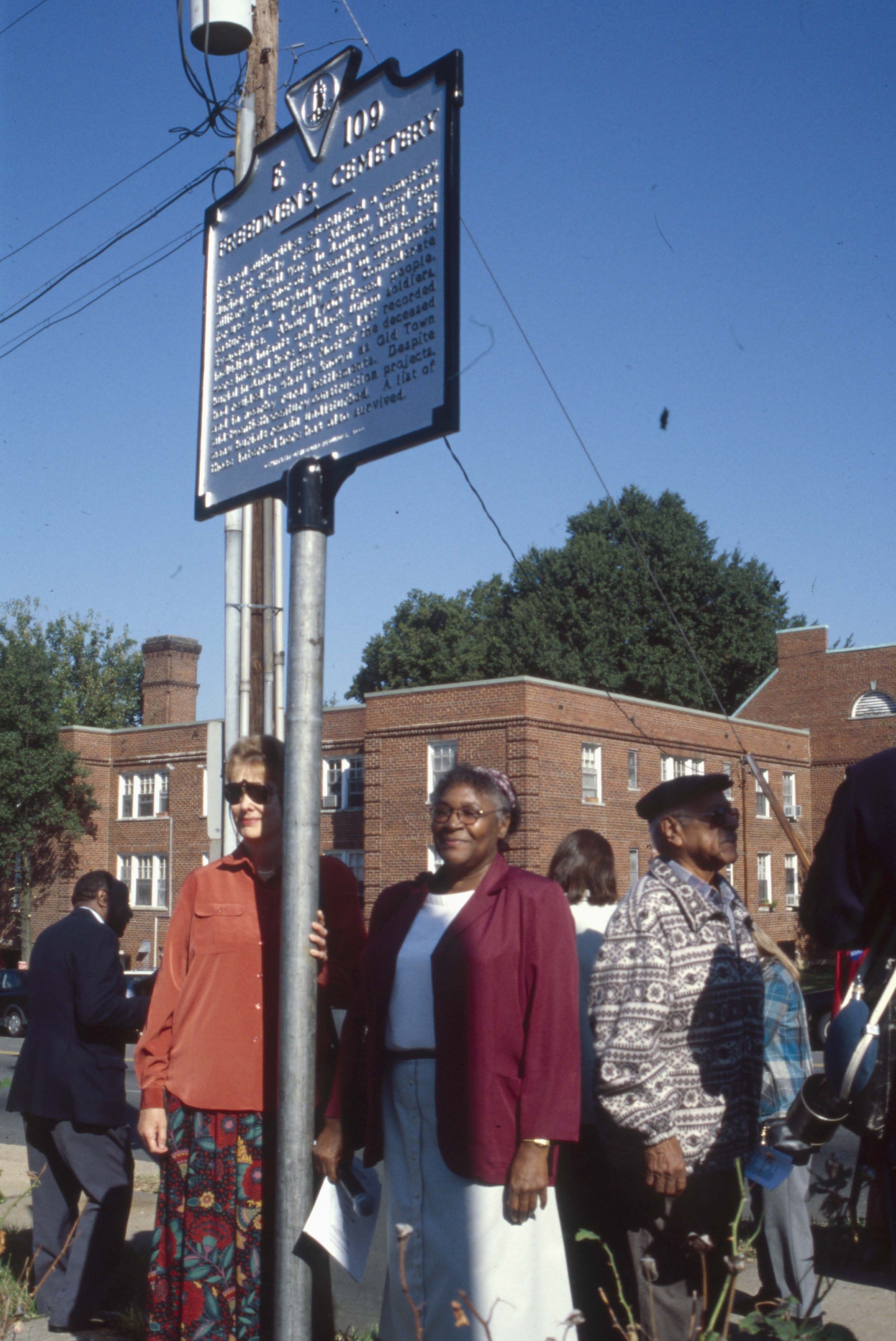
The efforts of the Friends of Freedmen’s Cemetery, the Alexandria Archaeological Commission, city archaeologists and many other local groups and private citizens eventually prompted the City of Alexandria to acquire the cemetery in order to preserve it. Workers tore down the gas station and office building, and the city government sponsored a competition to design a memorial for the site, which was dedicated in 2014. Historical research on the space continued. Archaeologists conducted surveys that identified grave sites without disturbing any human remains. Char McCargo Bah, a local genealogist and Friends of Freedmen’s Cemetery board member, worked to identify the descendants of people buried at the cemetery. By 2023, she had identified over 1,000 descendants.17 In 2024, many of these descendants traveled to Alexandria to participate in a ceremony honoring the tenth anniversary of the memorial’s dedication.18 Missing from the ceremony, however, were Finklea and Massoud. Both women had passed away, but their legacy was on full display.
Today, a majestic statue stands prominently on the site as part of the Contrabands and Freedmen Cemetery Memorial. Next to it is a partially-enclosed stone structure. Stepping into the space, a visitor encounters interpretation describing the cemetery’s history within the context of Civil War Alexandria. Illustrations show freedom seekers fleeing slavery and young Black children attending school in the city. On one wall is a list of the people who were laid to rest in the cemetery. Next to the list is a excerpt from Harriet Jacob’s letter describing the funeral of Peter Jefferson. Around the memorial, stone tablets mark the identified grave sites.


A Tribute to Those at Rest and Those Who Saved It
“We must always remember the sacrifices of those laid to rest here,” Lillie Finklea declared.19 Today, the Contrabands and Freedmen Cemetery Memorial serves a as tribute to the many freedom seekers who were laid to rest within its grounds. It provides a space for us, the living, to reflect on the bravery and heroism of those who were willing to risk their lives to try and secure their freedom and the freedom of their descendants. It also offers a chance to think about how the interpretation of Alexandria’s Civil War history has changed over time, and the people who have worked to save these sites and expand our understanding of the past. Peter Washington and other freedom seekers helped shaped the story of Alexandria and the United States. Local activists, archaeologists, and historians helped preserve a key place where that story played out.
If you ever visit Alexandria, take some time to go visit the cemetery. It’s about a five minute drive or a twenty minute walk from the heart of Old Town. When you arrive, look out over the grave sites, and then make your way through the gate and examine the interpretation within the memorial. See the names written on the wall and read the excerpt from Harriet Jacobs’ letter. Make sure you take a moment to remember and reflect on Peter Washington’s life and legacy.
And then take a moment to remember Lillie Finklea, Louise Massoud, and all those who worked to ensure that Peter Washington and the many other freedom seekers in Alexandria would never be forgotten.
Portions of this article are adapted from social media content I created for the Alexandria Historical Society.
All views expressed in this article are my own and do not represent the views of any of my employers, past or present. They also don’t represent the views of any organizations that I’m affiliated with.
Letter from Harriet Jacobs, Quoted in Report of Friends Associations for the Aid and Elevation of Freedmen May 23, 1864, in The Harriet Jacobs Family Papers, Jean Fagan Yellin, Joseph M. Thomas, Kate Culkin, and Scott Korb, eds., (Chapel Hill: University of North Carolina Press, 2008), pg. 574. Note: Jacobs letter doesn’t explicitly say that enslavers sold his family, just that he was suddenly “bereft" of them. However, historians have taken this to mean that they were sold away, a claim supported by Jacobs later saying that his children were “scattered” and not deceased.
Letter from Harriet Jacobs, pg. 574.
Letter from Harriet Jacobs, pg. 573.
Letter from Harriet Jacobs, pg. 574.
As always, if my readers have any historical details to share, please let me know.
Shoshanna Roth, “Freedmen’s Cemetery: Reclaiming Alexandria’s Contraband and Freedmen History,” in Alexandria at War 1861-1865: African American Emancipation in an Occupied City, Audrey P. Davis, ed, (Alexandria: Office of Historic Alexandria Press, 2023), pg. 4.
Roth, pg. 3.
“Uncanny Sight in a Graveyard,” The Washington Post, March 29, 1892, https://media.alexandriava.gov/docs-archives/historic/info/archaeology/contrabandscemeterywashingtonpost18920329graveyard.pdf
“A Brief History of Alexandria’s Freed People and of Freedmen’s Cemetery,” The Friends of Freedmen’s Cemetery, April 29, 2007, https://www.freedmenscemetery.org/history/history.shtml; Roth, “Freedmen’s Cemetery,” pg. 11.
Paula Haskins Williams, interview by Char McCargo Bah, June 21, 2008, Alexandria Legacies, Alexandria Oral History Archive, pg. 5, https://media.alexandriava.gov/docs-archives/historic/info/history/oralhistorywilliamspaulahaskins.pdf
Dr. Pamela Cressey, interview by Terilee Edwards-Hewitt, Old Dominion Boat Club, March 4, 2022, Alexandria Legacies; City of Alexandria Employees, Alexandria Oral History Archive, pg. 24. March 4, 2022. Disclaimer: Cressey is a friend.
Pam Cressey Oral History, pg. 24.
Pam Cressey Oral History, pg. 24.
Alice Reid, “Cemetery Prompts Questions on Bridge,” The Washington Post, January 30, 1997, pg. VA1A.
Douglas R. Appler, “The Formation of the Alexandria Archaeological Commission: Connecting Citizen Activism, Archaeology, and Local Government in Alexandria, Virginia,” in Journal of Community Archaeology & Heritage, Vol. 2, Number 1, 2015, pg. 34. Disclaimer: I serve on the Alexandria Archaeology Commission, but did not move to Alexandria until 2015.
Appler, “The Formation of the Alexandria Archaeological Commission,” pg. 34.
Roth, “Freedmen’s Cemetery,” pg. 9.
Char McCargo Bah, “Importance of Knowing Your History,” The Other Alexandria, November 19, 2024, https://theotheralexandria.com/2024/11/19/importance-of-knowing-your-history/; “Contrabands and Freedmen Cemetery Memorial 10th Anniversary,” City of Alexandria, last updated January 21, 2025, https://www.alexandriava.gov/archaeology/contrabands-and-freedmen-cemetery-memorial-10th-anniversary
“Visit Contrabands and Freedmen Cemetery Memorial,” City of Alexandria, last updated on December 24, 2024, https://www.alexandriava.gov/FreedmenMemorial